6 November 2026 · 7 min read
Can you add a card fee to a quote? What the price you show is allowed to leave out
Whether you may surcharge is the question the guides answer. Which number goes on the quote is the one you actually have.
Search whether you can charge customers a credit card fee and the pages that come back tell you it is mostly legal, there is a cap, and a few states say no. That is the answer to a checkout question. A business that quotes has an earlier one: the customer sees a number before they have chosen how to pay. What must that number include?
What the ranking pages say
Six pages, read 11 October 2026, all from payment or software companies and one bank. Counted:
- 2 of 6 state Visa's 3 percent cap. 3 of 6 mention that the fee also cannot exceed what card acceptance costs you.
- 3 of 6 say debit cards cannot be surcharged.
- 0 of 6 mention New York's total-price rule, California's price-advertising law or Minnesota's.
- 0 of 6 say what figure has to appear on a quoted or advertised price.
- The state lists disagree with each other, and two contain claims the states' own pages contradict.
The network rule
Visa's merchant Q&A sets four conditions. The surcharge is limited to your merchant discount rate for that card "or 3% whichever is lowest." You must notify your acquirer at least 30 days before you start. You cannot surcharge a debit or prepaid card, even one run as credit. And you must disclose it at the point of entry, at the point of sale, and as a separate charge on the receipt.
The first condition is the one a flat "3% card fee" quietly breaks. If your rate is below 3 percent, that is your cap.
What card acceptance costs on a $600 job
From Square's and Stripe's published prices:
| How the card is taken | Published rate | On $600 |
|---|---|---|
| Square, in person | 2.6% + 15¢ | $15.75 |
| Stripe, in person | 2.7% + 5¢ | $16.25 |
| Stripe, online | 2.9% + 30¢ | $17.70 |
| Square, online or invoice | 3.3% + 30¢ | $20.10 |
| Square, keyed in or card on file | 3.5% + 15¢ | $21.15 |
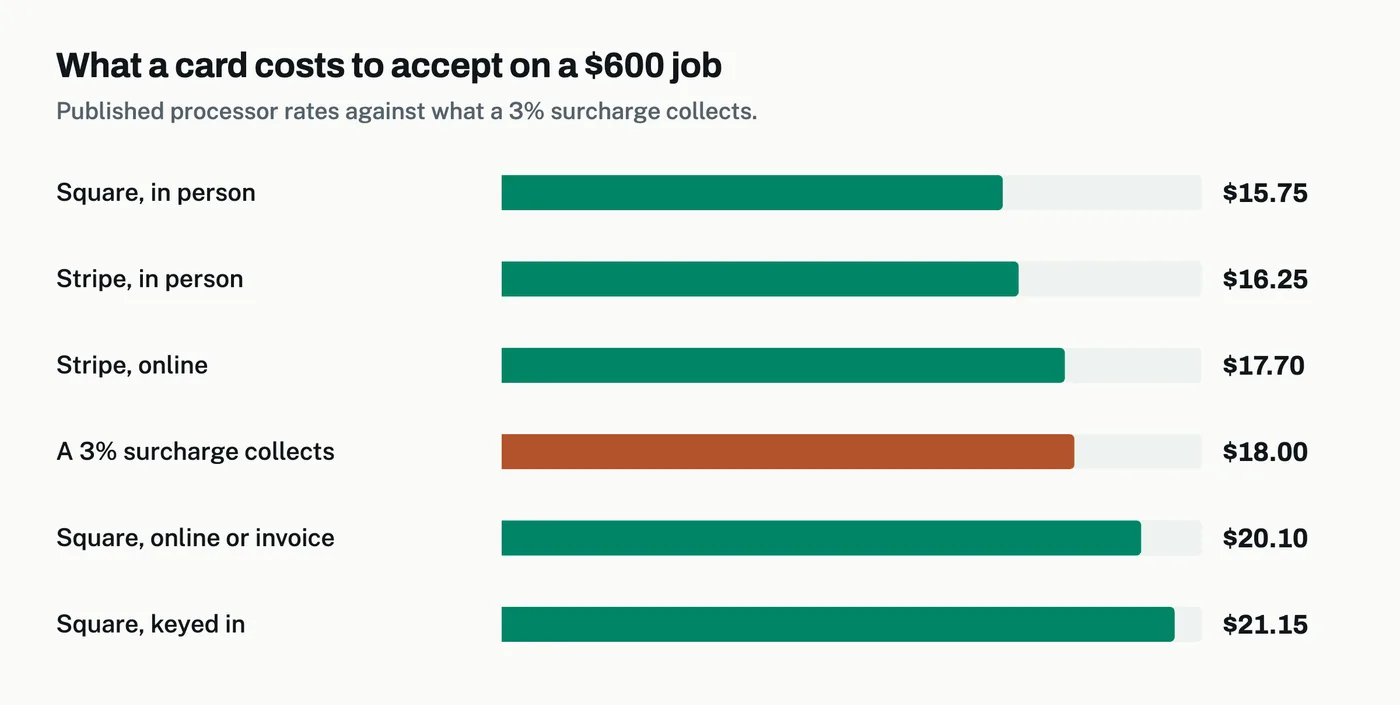
A 3 percent surcharge collects $18.00. Tapped in person it collects more than the card cost; sent as an invoice it collects less. The same job, the same card, and the method of taking payment decides which side of the cap you are on.
What the price you show must include
This is where the states differ, and where the guides stop.
| State | What its own source says |
|---|---|
| New York | You must post the total price for using a credit card, inclusive of the surcharge. The surcharge cannot exceed what the card company charges you. Penalty up to $500 per violation. |
| Minnesota | An advertised or offered price must include all mandatory fees — including any fee not reasonably avoidable by the consumer. |
| California | The advertised price must be the full price. A card fee the customer can avoid by paying another way generally need not be in it; if you take cards only, it must be. |
| Colorado | A surcharge of up to 2 percent, or up to your actual merchant discount fee. A separate line on the receipt, with prescribed notice wording, shown before checkout online. |
| Kansas | Permitted since 1 January 2025, with clear notice of the amount in advance. Older lists still show it as a ban. |
| Maine | A seller may not surcharge a credit or debit card. A discount from the regular price is not a surcharge. |
New York's governor published an example of what does not comply: a price shown as "$10.00, + 4 percent if paying with a credit card." The customer has to be shown the card total itself, in dollars. Showing two prices — card and cash — is allowed.
What that means for a quote
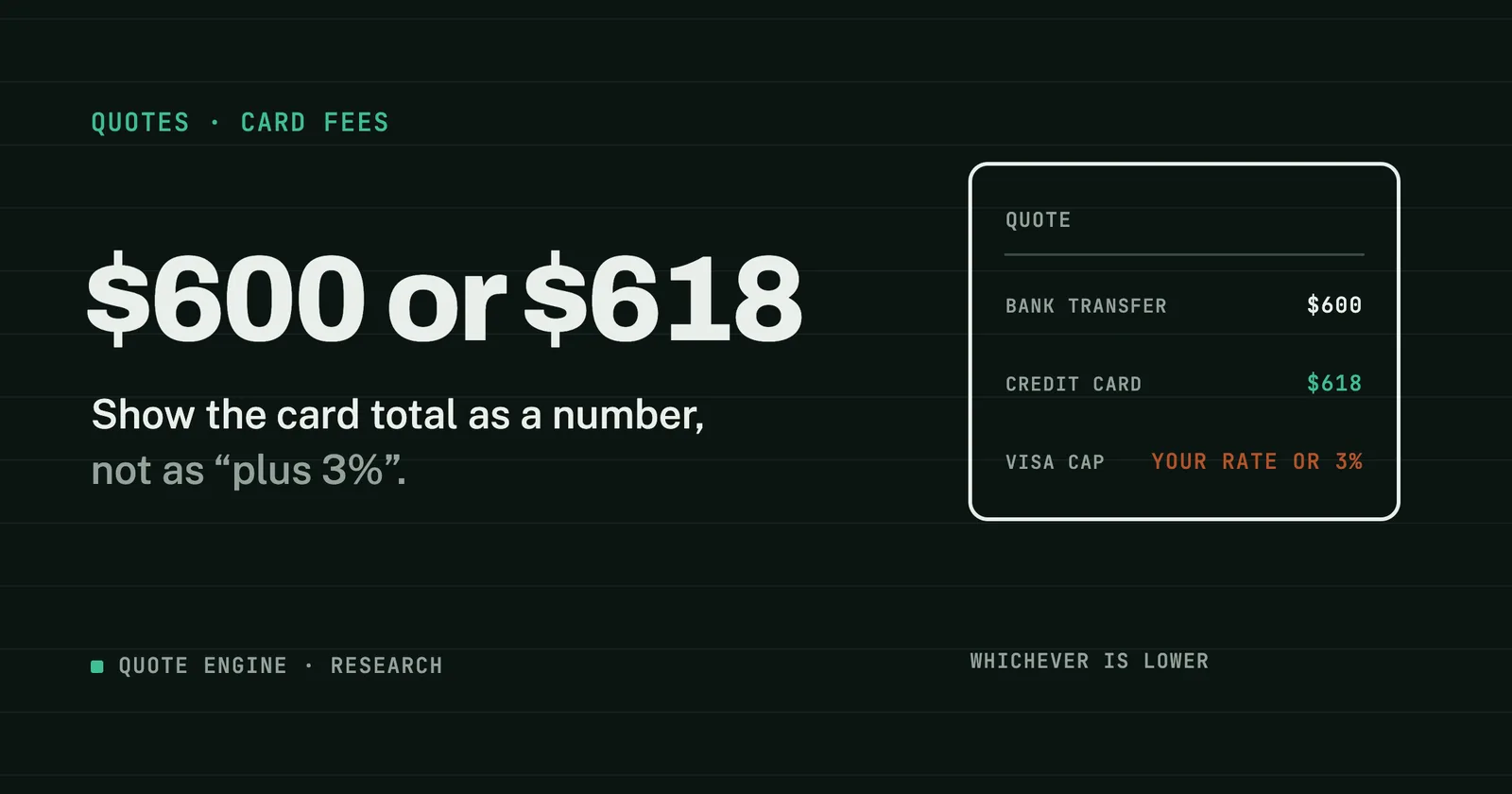
- Show the card total as a number. "$600, or $618 by credit card" works in every state above that permits a surcharge. "$600 plus 3%" does not work in New York, and it makes the customer do your arithmetic everywhere else.
- Leave a way to avoid it. The California and Minnesota rules both turn on whether the fee can be avoided. If a bank transfer or a cheque gets the lower price, the fee is a choice. If card is the only way to pay, it is part of the price and belongs in the headline figure.
- Check your own rate before you write 3%. The cap is your cost or 3 percent, whichever is lower, and never on debit.
- Or price it in. One price, any method, is legal everywhere, needs no notice to your processor and no sign. A discount for cash or bank transfer gets you most of the same result, and even Maine's ban says a discount is not a surcharge.
A price that changes after the customer has agreed to it is the thing every one of these rules is written against. Put both numbers where the first one goes.
Where these figures come from
Network rules are from Visa's US merchant surcharge Q&A, version dated 15 February 2024; Mastercard's pages refused our requests and its rules are not described here. State rules are from each state's own statute page or attorney general's publication, linked above; Colorado is read from the attorney general's 2022 opinion letter rather than the statute, and applying Minnesota's rule to card fees is our reading of its wording. Several other states have rules we could not read from an official source and have left out — this is not a complete list. Processor rates are from Square's and Stripe's price pages. All were read on 11 October 2026. The count of pages is our own; they are counted, not named. This is not legal advice.
This is the product, if you want it.
Quote Engine puts a real price on a service business's own website — built from what you already charge, and honest enough to hand over the jobs it should not price.