9 October 2026 · 7 min read
How to price dump fees into a junk removal job: what a truckload weighs and what the scale charges
You sell by the eighth of a truck. The scale house sells by the ton. The gap between the two is where the margin goes.
Search how to factor dump fees into a junk removal price and the advice is unanimous: include them. Add disposal to labour, fuel and overhead, then put a margin on top. That is right, and it is also the whole of what most guides say. The part they leave out is the conversion — you sell space in a truck, and the transfer station bills you by weight, at a rate set by your county.
What the ranking guides say
We read the five pages ranking for that search on 9 October 2026, skipping homeowner cost guides and directories: Housecall Pro, Jobber, Method, Always Do Better and CurbWaste. All five are written for owners. Counted across them:
- 5 of 5 tell you to build disposal into the price.
- 1 of 5 gives a per-ton figure — CurbWaste puts typical landfill fees at $25 to $150 a ton depending on material and location.
- 2 of 5 give a per-item figure at the dump, for mattresses or televisions.
- 0 of 5 say what a load of any material weighs.
- 0 of 5 mention a scale-house minimum charge, or that the same facility can charge different customers different rates per ton.
Always Do Better comes closest, with one good line: a scale ticket beats a guess every time. The rest of this post is the guess, done properly, so you can check it against your tickets.
What a truckload weighs
The Environmental Protection Agency publishes the conversion the guides skip. Its Volume-to-Weight Conversion Factors memo, April 2016, gives pounds per cubic yard for the materials a junk crew actually loads:
| Material, per cubic yard | EPA estimate | Full 15 cu yd truck |
|---|---|---|
| Commercial waste, uncompacted | 138 lb | about 2,070 lb |
| Mixed household waste, uncompacted | 250–300 lb | about 3,750–4,500 lb |
| Clean dimensional lumber | 169 lb | about 2,535 lb |
| Construction and demolition, bulk | 484 lb | about 7,260 lb |
| Gypsum board | 467 lb | about 7,005 lb |
| Composition roofing | 731 lb | about 10,965 lb |
| Concrete | 860 lb | about 12,900 lb |
The right-hand column is our arithmetic, on a 15-cubic-yard box — inside the 360 to 480 cubic feet Jobber gives for a full truckload. Single items are in the same memo: a refrigerator at 250 lb, a clothes washer at 150, a dishwasher at 125.
Two things fall straight out of that table. A truck of shingles or concrete weighs roughly two and a half to three and a half times what a truck of household junk does, so pricing it by the eighth undercharges it by about the same multiple at the scale. And a full truck of shingles is more than five tons — check the payload rating on your own truck before you sell anybody a full load of anything in the bottom three rows.
What the scale charges for it
Disposal fees are set locally, and counties publish them. We read three, chosen for spread rather than as a sample:
| Facility | Garbage, per ton | Minimum |
|---|---|---|
| King County, WA — self-haul, current | $243.38 | $40.25, loads up to 320 lb |
| King County, WA — self-haul, from 1 January 2027 | $264.01 | $43.50 |
| Fairfax County, VA — commercial, FY2027 | $98 | $39 / $49 / $98 by load size |
| Salt Lake County, UT — mixed trash | $36 | $17 a load, plus fees |
The sources are King County's disposal fees page and its 29 September bulletin announcing 2027 rates, Fairfax County's commercial disposal fees, effective July 2026 to June 2027, and Salt Lake County's landfill pricing. King County's figures include its moderate risk waste surcharge and Washington's 3.6 percent refuse tax.
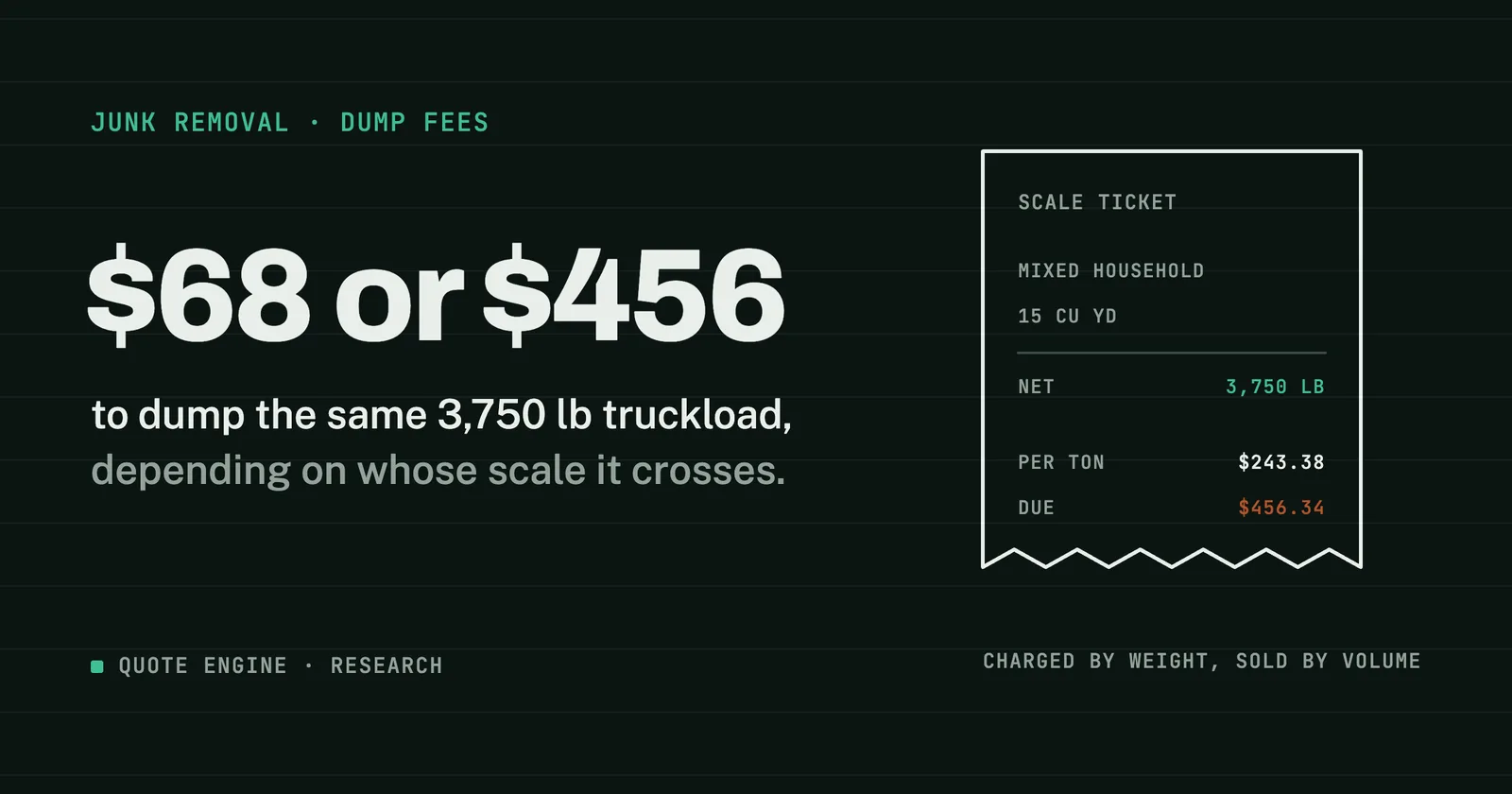
Put the two tables together and the same 3,750 lb truck of household junk costs about $456 to dump in King County today, $184 in Fairfax County and $68 in Salt Lake County. On 1 January the King County figure becomes about $495 — an 8.5 percent rise with no change to the load.
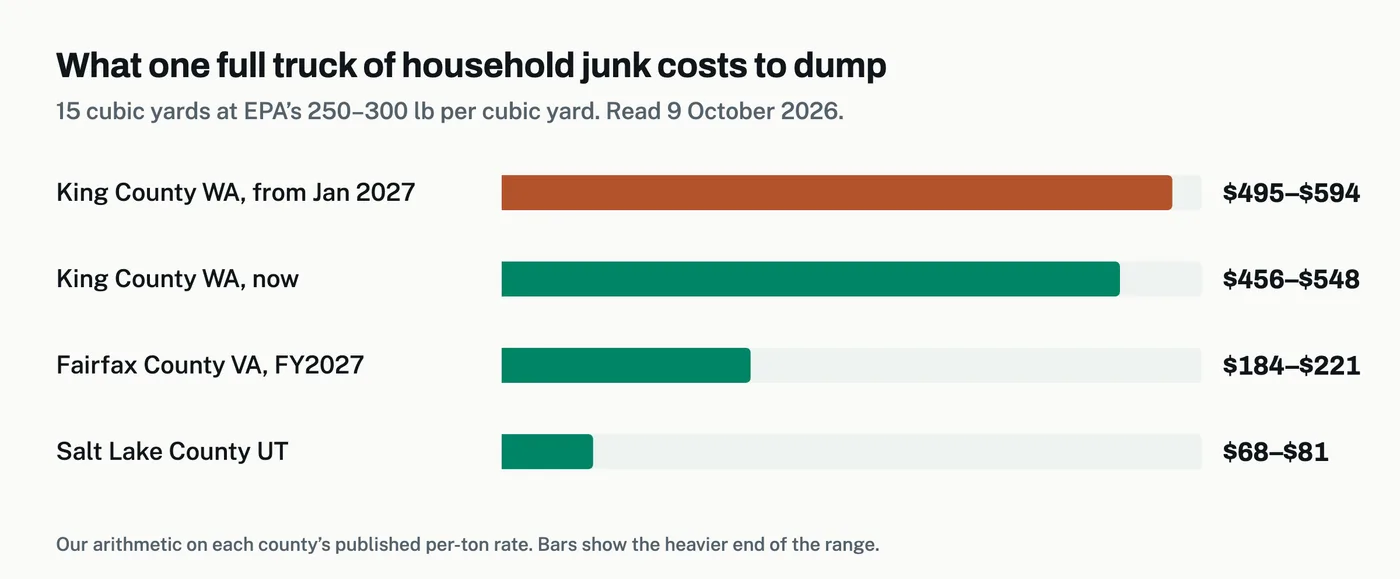
Set that against the published price of the job. Housecall Pro's guide puts a full truckload at $600 to $800. In Salt Lake County the dump is around a tenth of that. In King County, at the heavier end of household density, it can be most of the bottom of the range — before labour, fuel or the truck.
Three things on the fee schedule the guides do not mention
- The minimum decides your small jobs. An eighth of a 15-yard truck is under two cubic yards. At EPA's commercial-waste density that is about 260 lb — under King County's 320 lb threshold, so it pays the $40.25 minimum no matter what is in it. If your minimum pickup is $70 to $150, as the guides suggest, a single-item run to a King County station spends between a quarter and more than half of that at the gate.
- The rate class is not the same for everyone. King County's 2027 table charges self-haul customers $264.01 a ton and its contract collection companies $207.03, plus their fixed annual charge. Fairfax County bills bonded collection and disposal companies monthly and charges others at the gate. Which line your ticket is printed on is worth a phone call to the scale house — we could not tell from the published pages which one a junk removal company falls under.
- Some items are priced per piece, not per ton. King County charges $33.39 to dispose of a mattress and $30 for a refrigerator or freezer. Salt Lake County charges $18 a mattress, $20 a refrigerant unit and $4 a tire, twelve to a load. Fairfax County has suspended commercial tire disposal altogether. Those belong on your rate card as items, because the dump treats them as items.
What this means for the price on your website
Pricing by the eighth is right for the jobs it fits: light, mixed household loads, where volume and weight move together closely enough that the scale ticket lands where you expected. The table says where it stops fitting. Building it into a price you publish means four rules:
- Price each tier from your own scale rate. An eighth that is profitable at $36 a ton is a different number from one at $243. A national guide's tier prices assume a dump fee that may be a sixth of yours, or six times it.
- Take heavy material out of the volume tiers. Shingles, concrete, drywall and dirt do not belong in "half a truck". Price them by weight, or hand them to a person — a quote that guesses here is a quote you lose money on.
- List per-piece items as items. Mattresses, refrigerators and tires carry their own fee at the gate, and the customer can name them exactly.
- Change the price when the county does. King County's rate moves on 1 January. A tier price set in October is out of date by the second week of the new year, and every published price should know which disposal rate it was built on.
None of that is a reason not to publish a price. It is the reason the price has to come from your numbers — and why we wrote up what to do with that number once you have it.
Where these figures come from
Weights are from EPA's Volume-to-Weight Conversion Factors for Solid Waste, April 2016. Disposal fees are quoted from King County's disposal fees page and its 29 September 2026 bulletin of 2027 rates, Fairfax County's FY2027 commercial disposal fees, and Salt Lake County's landfill pricing page, which carries no effective date. The five guides were read for the counts above, and the full-truckload figures are Housecall Pro's and Jobber's. Everything was read on 9 October 2026. Full-load weights, per-load dump fees and the percentage rise are our arithmetic on those pages, on a 15-cubic-yard truck, and are approximate. EPA's figures are averages; your scale tickets are the real number. Fees change — check your own facility before relying on any figure here.
This is the product, if you want it.
Quote Engine puts a real price on a service business's own website — built from what you already charge, and honest enough to hand over the jobs it should not price.