3 November 2026 · 7 min read
How fast should you answer a quote request? What the five-minute studies actually measured
The direction of the evidence is sound: faster is better, and most businesses are slow. The precision bolted onto it is not.
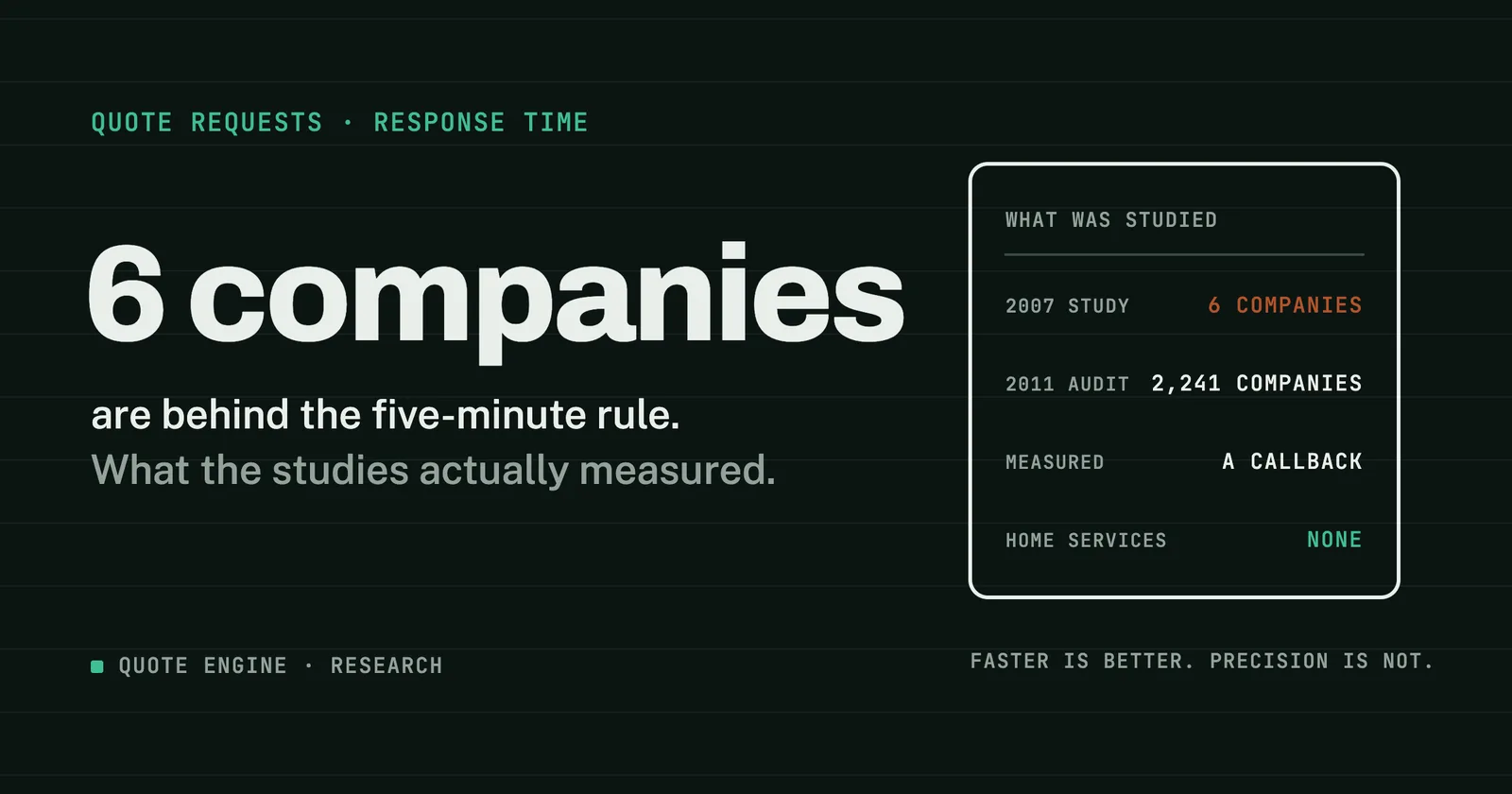
Search how fast to respond to a quote request and every page gives the same answer, with the same numbers attached: five minutes, 100 times, 21 times, 78 percent. We went and read the studies. The advice survives. The numbers mostly do not.
What the ranking pages say
Five pages written for home-service businesses, read 11 October 2026. All five are published by companies that sell lead-response software or marketing. Counted:
- 4 of 5 say 78 percent of customers buy from the first company to respond. 0 of 5 attribute it to a study with a method.
- 4 of 5 quote "100 times"; 3 of 5 quote "21 times".
- 1 of 5 links to a primary source. 1 of 5 gives a sample size.
- 0 of 5 say which industries the studies covered, or that none of them was home services.
The 2007 study: six companies
"100 times" and "21 times" come from the Lead Response Management Study, presented at a marketing conference in October 2007 by a sales-software company, InsideSales.com, with James Oldroyd. The original report is still online, and it is plain about what it is:
- Three years of data from six companies, all users of the vendor's own system: over 15,000 leads and over 100,000 call attempts.
- The six companies' industries are not stated.
- "Response" meant an outbound phone call to someone who had filled in a web form.
- The 100-times figure is the odds of reaching the lead when called within 5 minutes rather than 30. The 21-times figure is the odds of qualifying them.
- In its own words: "This study did not address close ratios."
It also carries a caveat that never makes the trip into the blog posts: the patterns appear only when the companies' data is pooled, and vary significantly from one company to the next. Three of the five pages we read turn "qualify" into "convert".
The 2011 article: no minutes in it
The other source everyone names is a Harvard Business Review piece from March 2011. It is 442 words long and the word "minutes" does not appear in it. It reports two separate studies, which are usually merged into one:
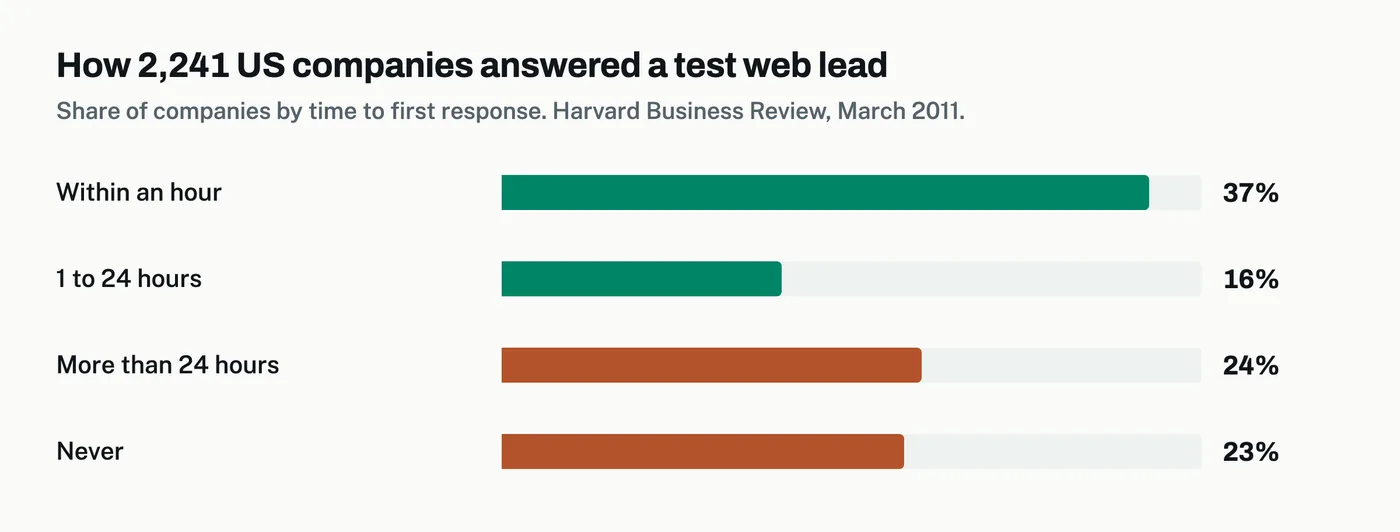
- An audit of 2,241 US companies, timing how long each took to answer a test web lead. 37 percent responded within an hour; 23 percent never responded. The average, among those that answered within 30 days, was 42 hours.
- A separate analysis of 1.25 million leads at 42 companies. Firms that tried to make contact within an hour were nearly seven times as likely to qualify the lead as those that waited an hour longer.
"Qualify" is defined there as a meaningful conversation with a decision maker. The sectors it names are financial services, cars, education, software, health care and professional services.
The two with no study behind them
"78 percent buy from the first to respond." We could not find an original. The home-service pages attribute it to each other, to "a survey", or to nothing. The trail ends at a name with no title, year, sample or document attached.
"391 percent more conversions in the first minute." The earliest copy we found is a sponsored press release from June 2010 by a lead-management vendor, citing "several million leads" with no company count, no industries and no statement of what the 391 percent is compared with.
What does hold
Strip the false precision and three things are left standing:
- Faster is better, in every dataset. Hourly in one, by the minute in another, in different industries and years. Nobody has found the opposite.
- Most businesses are slow or silent. In the 2011 audit, 47 percent took over a day or never answered. A 2014 audit by the same vendor of 9,538 companies found 47 percent did not respond at all. One agency's test of 466 home-service companies reports that 40 percent never replied, though its page gives no method.
- None of it measured what you want to know. Every study timed a callback to a web form. None tested a home-service business answering a price question, and none tested the case where the answer is on the page before anyone calls.
Our own count points the same way. Of forty home-service websites we opened by hand in August 2026, 36 had a quote form and one gave a figure without a person involved. That is not a response-time study either — it is a count of who answers at all.
What to do with it
- Measure your own. Time from form to first reply, and bookings by how long that took. Fifty enquiries of your own tell you more than six companies in 2007.
- Beat "tomorrow" before you chase "five minutes". The audits say the competition is mostly a day late or absent. Same-hour is already the front of the queue.
- Answer the jobs that can be answered. Where the price follows from what the customer can tell you, the fastest reply is the one that needs nobody to send it. Keep the phone for the jobs that need eyes.
- Quote the claim you can stand behind. If a vendor tells you 78 percent, ask for the study.
Where these figures come from
The 2007 figures are from the Lead Response Management report (InsideSales.com, 1 November 2007), read in full. The 2011 figures are from the body of the Harvard Business Review article, which may sit behind a paywall for some readers. The 2014 figures are from that year's InsideSales lead response report. The 2010 release is quoted as published. All were read on 11 October 2026. Where we say we could not find a source, that is a statement about our search, not proof that none exists. The count of pages is our own; they are counted, not named.
This is the product, if you want it.
Quote Engine puts a real price on a service business's own website — built from what you already charge, and honest enough to hand over the jobs it should not price.