2 October 2026 · 7 min read
How to price pressure washing jobs: four rate cards operators actually publish
Every guide tells you how to work out the number. Four operators show what it looks like once it is on the page.
Search how to price pressure washing jobs and you get the same three models every time: by the square foot, by the hour, or a flat rate per job. The guides explain them clearly. Then they stop, at exactly the point where the number would have to go somewhere a customer could see it.
What the guides say, and what they leave out
We read the five pages ranking for that search on 2 October 2026, skipping directories and homeowner cost calculators. All five are field-service software companies writing for owners. Three put a per-square-foot figure on the page, and the figures do not agree:
| Guide | Per square foot |
|---|---|
| Housecall Pro, residential flatwork | $0.15–$0.75 |
| Jobber, general | $0.10–$0.50 |
| Swivl, driveways and concrete | $0.15–$0.30 |
| Swivl, house washing | $0.20–$0.45 |
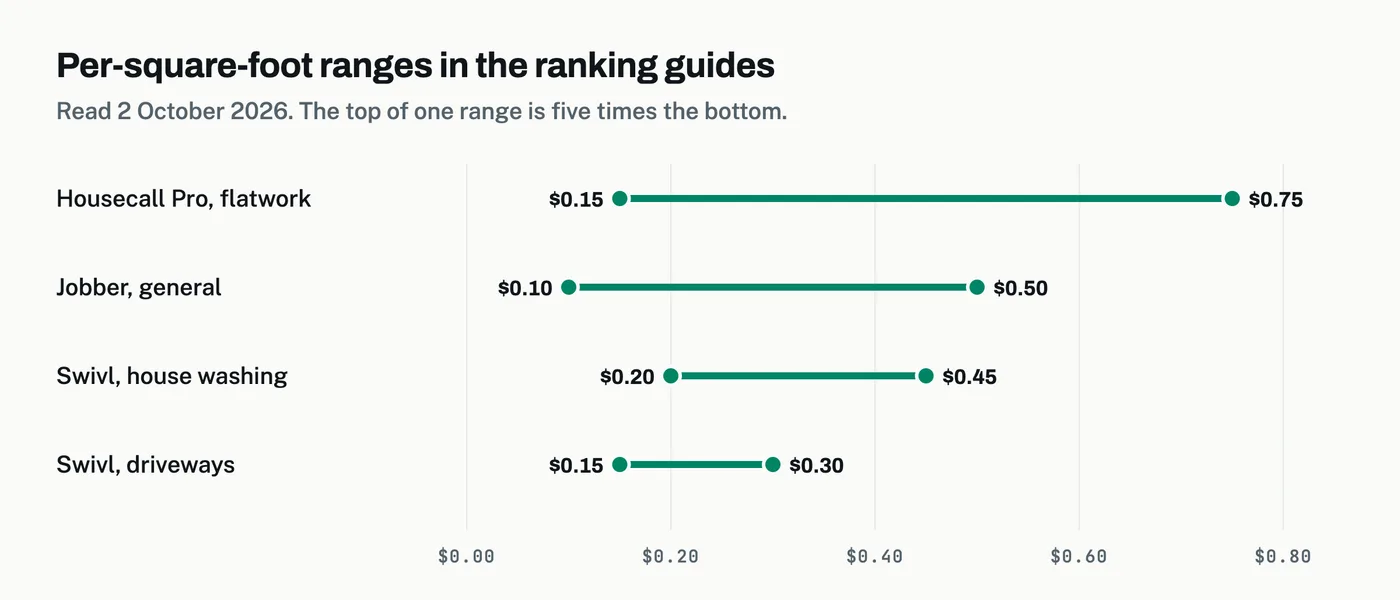
The top of one range is five times the bottom of it. That is not carelessness on anybody's part — it is the honest spread of a national average across every market and every kind of dirt. But it means the guides cannot hand you a number. They hand you a method, and the number has to come from your own costs.
Counted across the five:
- 3 of 5 publish a per-square-foot range.
- 0 of 5 discuss putting your prices on your own website.
One comes close. Swivl's guide makes the point that matters most and then leaves it there: the homeowner comparing three washers usually books the one who answered first with a professional price.
Why this trade, of all of them
When we opened forty home-service websites by hand in August, exterior cleaning stood out. Four of the eight pressure washing and exterior cleaning sites published a real number. Among roofers it was one in twelve.
The reason is the job itself. A house wash is mostly square footage and the number of storeys, and the customer already knows both. Nothing about it needs a diagnosis. That makes it the trade where the question of whether to publish is most answerable — so it is worth looking at how the operators who already do it have laid it out.
Four rate cards, four shapes
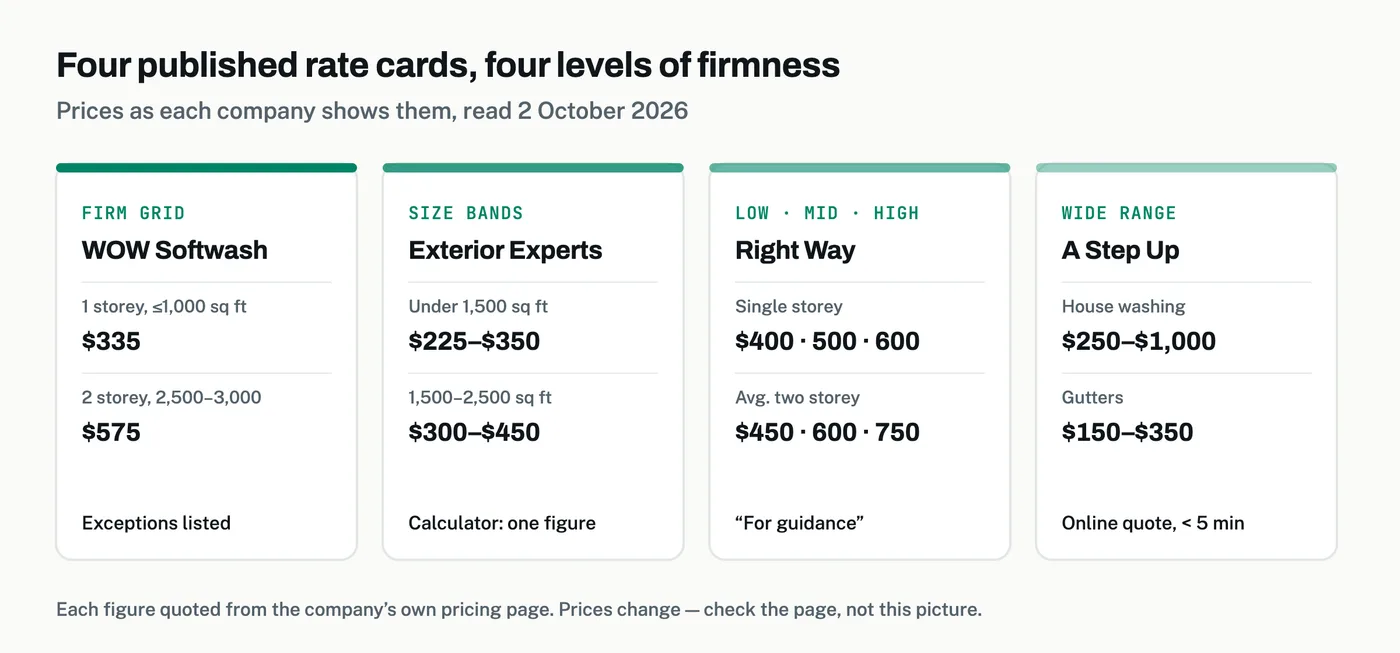
These are four exterior-cleaning companies, in four different states, that publish prices on their own sites. They are not a sample of anything; they are worked examples. Each one has made a different choice about how firm to be.
1. A firm grid, with the exceptions written down
WOW Softwash, in the Portland, Oregon area, publishes a grid: the house's square footage down one side, single or two storey across the top, and a price in each cell. A house soft wash runs from $335 for a single-storey home up to 1,000 sq ft, to $575 for a two-storey at 2,500–3,000 sq ft. Roof cleaning, gutters and driveways get the same treatment; driveways and patios start at $215.
What makes it work is the list underneath. Three-storey homes, roofs steeper than 6/12, tile, shake and membrane roofs, gutter guards — each is named as costing extra or needing a job-specific quote. The grid answers the ordinary house, and the page says plainly which houses are not ordinary.
2. Ranges by size, plus a calculator that returns one figure
Exterior Experts, an owner-operator in Cookeville, Tennessee, publishes ranges in size bands for six services. A house wash is $225–$350 under 1,500 sq ft, $300–$450 for 1,500–2,500, and $400–$575 for 2,500–3,500. A standard 300–600 sq ft driveway is $125–$225.
The ranges let a visitor see roughly where they stand. Then the page offers an instant quote tool that, in its own words, calculates an exact quote — not a range. The published table does the browsing; the calculator does the committing.
3. Low, medium and high, labelled as guidance
Right Way Power Washing, in Naperville, Illinois, publishes a table by type of home with three columns: low, medium, high. A single-storey home is $400, $500 or $600; an average two-storey is $450, $600 or $750; the largest properties run to $3,000.
Directly under it: "Pricing above is for guidance - not final pricing." The page then lists what moves a house between the columns — age, material, condition, access, height, vegetation — and offers an inspection on site or by satellite. Nobody reading it is surprised later.
4. Wide ranges in the copy, and an online quote
A Step Up Home Washing, in Lakeville, Minnesota, states its ranges in a sentence: $250 to $1,000 for house washing, $150 to $350 for gutters, $400 to $3,000 for roof cleaning. Those are wide, and on their own they would not settle much. Their job is to set expectations; the narrowing is done by an instant online quote system that, the site says, reveals the cost in under five minutes.
What the four have in common
They chose different levels of firmness, from a fixed price per cell to a range labelled as guidance. Underneath, all four do the same three things:
- They price by what the customer already knows. Square footage, storeys, linear feet of gutter, number of windows. Nobody is asked to judge how dirty their siding is.
- They say where the published price stops. Three storeys, steep pitch, specialty roofs, mansions. Outside that line the answer is a conversation, and the page says so rather than stretching the grid to cover it.
- They do not pretend the number is final when it is not. "Starting at", "guidance", "your exact price depends on your property". A published price with an honest caveat still answers the 9pm question; a hidden one does not.
Those three are the same rules a sound quote follows anywhere: inputs the customer can answer, a floor and a ceiling, and a handoff to a person for what falls outside. The guides teach you to produce the number. These four show that, in this trade at least, the number can be shown.
Building your own
Start from your own jobs, not from the national ranges above. Take last season's invoices, sort them by house size and storeys, and the cells of your grid are mostly already there. The smallest job you would send the rig to is your floor. The house you would not price without seeing it is your ceiling. Everything in between can go on the page — firm, as a range, or behind a calculator — and the choice between those is how confident your invoices let you be.
Where these figures come from
The per-square-foot ranges are quoted from the three guides linked above; the counts are from the five pages ranking for the search, all read on 2 October 2026. Each operator's prices are quoted from their own pricing page, linked, read the same day — prices change, so check the page rather than this one before relying on a figure. The four-of-eight count is from our own survey of forty sites, opened by hand between 30 and 31 August 2026. Businesses are named here only where naming them is a compliment.
This is the product, if you want it.
Quote Engine puts a real price on a service business's own website — built from what you already charge, and honest enough to hand over the jobs it should not price.