23 October 2026 · 7 min read
Pressure washing wastewater rules: the fine the blogs quote, and the one you would actually get
The federal number is bigger than the blogs say and almost never the one that matters. The city number is smaller, written down, and enforced on complaints.
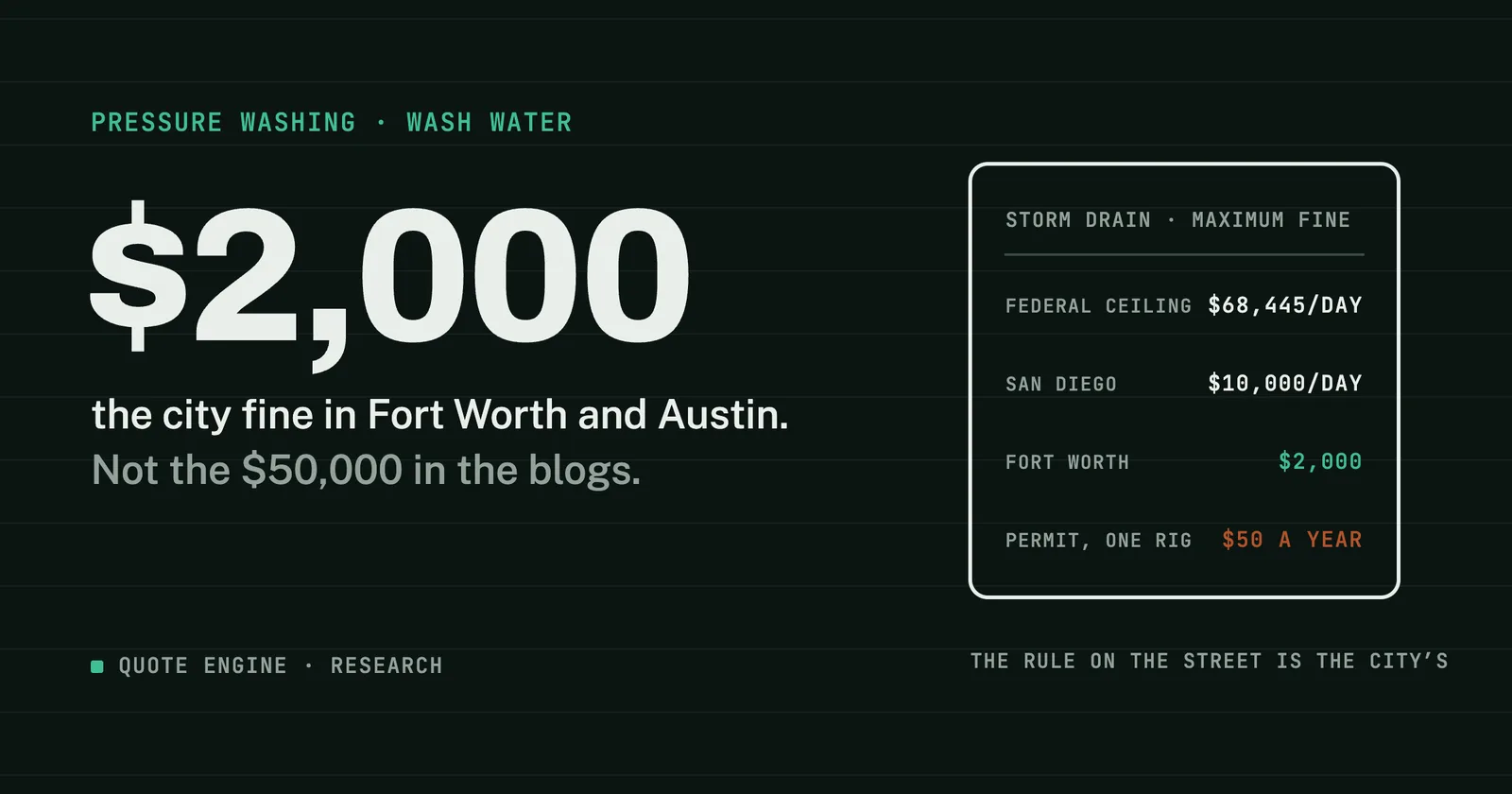
Search pressure washing wastewater regulations and you will be told the EPA can fine you tens of thousands of dollars a day for letting wash water reach a storm drain. That is roughly true, usually misquoted, and mostly beside the point. The rule you will meet on a driveway belongs to the city.
What the ranking pages say
We read five pages on 11 October 2026; two more would not load. Counted:
- 3 of 5 give a fine: "$1,000 to $25,000 per day" on one, "up to $50,000 a day" on two. 0 of 5 name the document it comes from.
- 1 of 5 cites a section of the Clean Water Act. 0 of 5 cite a city code.
- 0 of 5 say whether plain water, with no soap, is treated differently.
- 0 of 5 say what recovering the water adds to the price of a job.
- Two of the five were written in 2012 and 2013.
The federal number
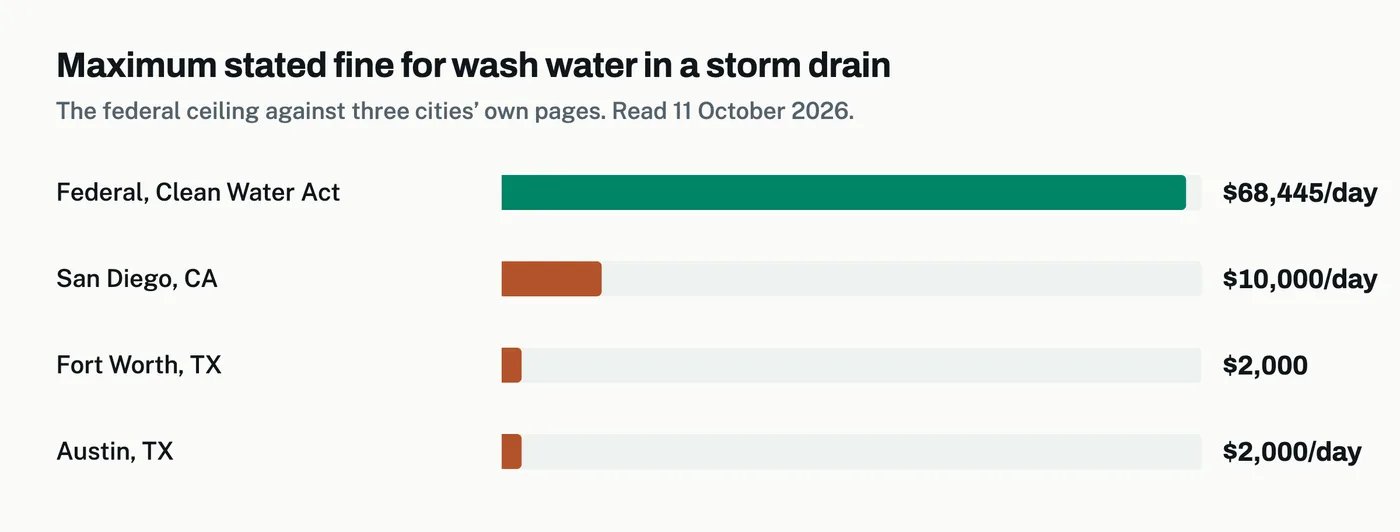
The Clean Water Act's civil penalty was enacted at $25,000 per day per violation, which is where the older figure comes from. It is adjusted for inflation, and the current amount is in 40 CFR 19.4: $68,445 per day, for penalties assessed on or after 8 January 2025. We could not find a source for $50,000.
That is a ceiling for the worst industrial discharger, and we found no case of it being applied to a mobile washer. What the federal rules do is tell cities to act. 40 CFR 122.26 defines an illicit discharge as anything entering a municipal storm sewer "that is not composed entirely of storm water," and cities with a stormwater permit must prohibit those by ordinance. The short federal list of tolerated flows includes residential car washing and street wash water. Commercial pressure washing is not on it.
The number on the street
Six cities, each from its own stormwater or permit page:
| City | What it asks of a mobile washer | Stated fine |
|---|---|---|
| Fort Worth, TX | A permit: $25 for the business, $25 per wash unit, yearly | Up to $2,000 per offence |
| Austin, TX | No untreated wash water with pollutants or cleaning compounds to the storm sewer; sewer disposal only at a permitted site | Up to $2,000 per day per violation |
| San Diego, CA | No polluted water to the storm drain; landscaping, sewer or dump station instead | Up to $10,000 per day per incident |
| Houston, TX | A permit; booms, mats and recovery systems tested by the city | Not on the page |
| San Antonio, TX | Registration for anyone power washing for pay | Not on the page |
| Bellingham, WA | Nothing but rain in the storm drain; the city lends a reclaim kit free | Not on the page |
Does plain water count?
This is the question operators actually ask, and the cities answer it. Fort Worth's own question-and-answer sheet takes a parking lot washed with water only and says: "Probably not." Its reasoning is the useful part — it is not only the chemicals you use, it is what you wash off. The same sheet says a biodegradable detergent can kill fish as fast as any other.
Bellingham allows nothing but rain. Austin's rule turns on pollutants, not soap. A sidewalk rinsed clean of dust is one thing; a drive-through pad with oil on it is another, whatever is in your tank.
Where the water can go
The cities name the same three routes, each with a condition:
- Onto landscaping, with the owner's permission, no chemicals, and — San Diego's wording — not leaving until it has soaked in.
- Into the sanitary sewer, with permission, and in Fort Worth and Austin only through a permitted route. Fort Worth adds limits: no grease or grit, 150°F at most.
- Collected and hauled to a dump station or a permitted facility.
Putting it in the price
None of the pages we read puts a number on compliance, so here is one. A distributor lists a 20-foot vacuum boom, without the vacuum, at $1,149, and a 40-foot one at $2,172. Over 250 jobs that is $4.60 or $8.69 a job for the boom alone — our arithmetic, and it leaves out the vacuum, the tank, disposal and the bigger cost, which is the time. A Fort Worth permit for one rig is $50 a year.
Which means recovery is not a cost to bury. It is a line that belongs to particular jobs:
- Ask what the surface is, not just how big. House siding onto a lawn and a restaurant pad beside a storm inlet are different jobs at the same square footage. The customer can tell you which they have.
- Price recovery as its own line on flatwork that drains to the street and on anything commercial. A customer comparing two quotes can see why yours is higher, and so can an inspector.
- Send the hard ones to a person. Fuel stations, dumpster pads, fleet washing: these need somebody to look at where the water goes before there is a price.
Read your own city's page first. The rules above differ in almost every detail, and the only one that applies to you is the one with your city's name on it.
Where these figures come from
Federal amounts and definitions are from 40 CFR 19.4 and 122.26 as shown on the eCFR, up to date as of 7 October 2026. City requirements and fines are as stated on each city's own page or fact sheet, linked above; several pages are undated and we did not read the municipal code sections behind them. Equipment prices are a distributor's listed prices. All were read on 11 October 2026. The count of pages is our own; they are counted, not named. This is a reading of published rules, not legal advice.
This is the product, if you want it.
Quote Engine puts a real price on a service business's own website — built from what you already charge, and honest enough to hand over the jobs it should not price.