27 October 2026 · 7 min read
How to price full value protection: on an interstate move it is the default, not the upsell
Sixty cents a pound is the exception a customer signs for. Six dollars a pound is where every interstate estimate has to start.
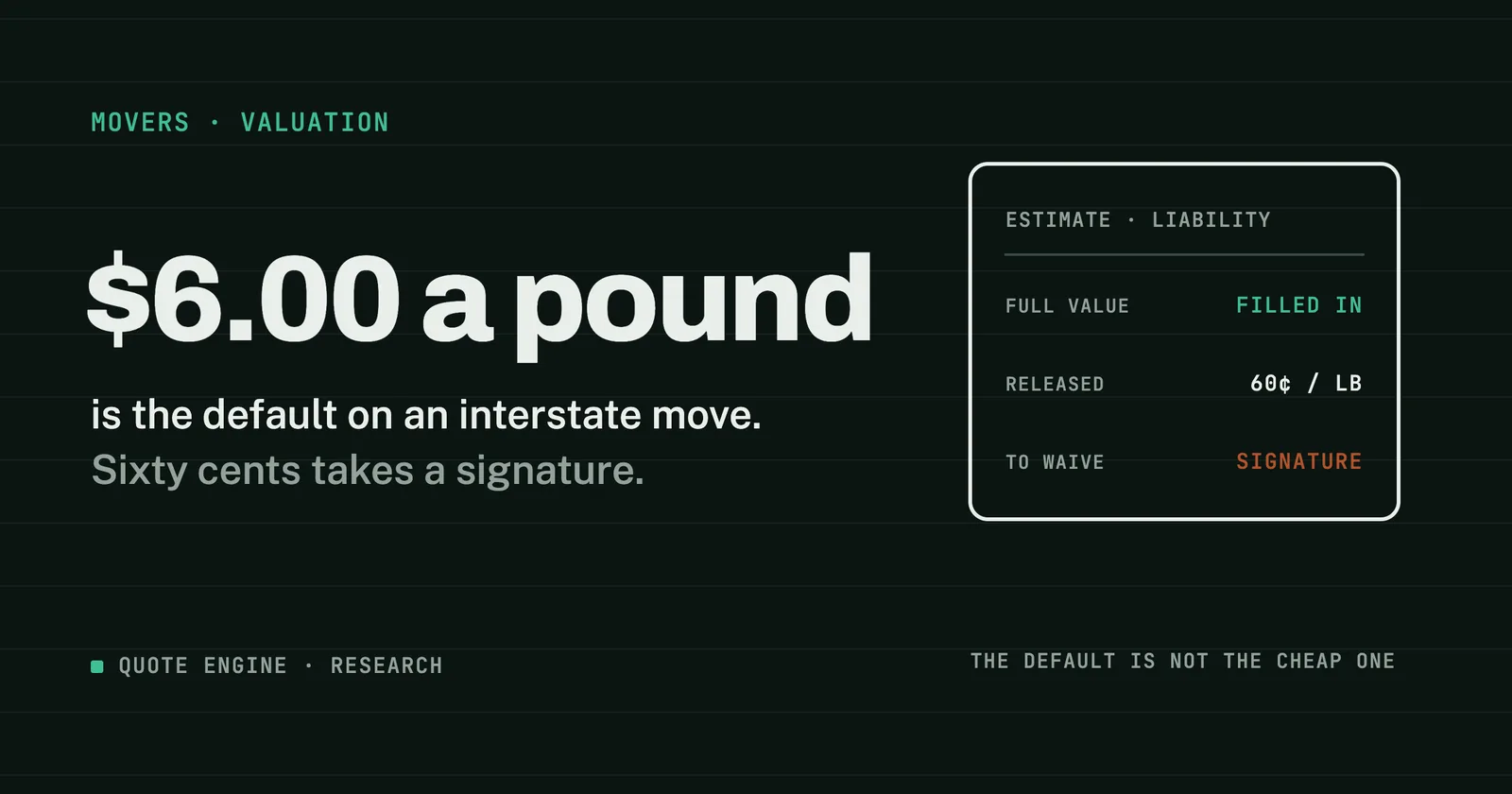
Search how to price valuation coverage and the guides for movers describe an upsell: basic coverage is free at 60 cents a pound, and full value protection is a product you can offer for more. On an interstate move that picture is upside down, and the estimate form is where it shows.
What the ranking pages say
Five pages, read 11 October 2026. Only three are written for movers; consumer pages fill the rest of the results. Counted:
- 2 of 5 state or imply that released value — 60 cents a pound — is the default.
- 1 of 5 says full value is the default and that its cost must be on the estimate. It is a forum post from 2012.
- 2 of 5 give a price for full value protection: one around $1 per $100 of declared value, the other $45 per $1,000. Those differ by more than four times.
- 0 of 5 cite a section of the regulations. 0 of 5 mention that the charge must be in the mover's tariff.
What the rules say
49 CFR 375.201 makes a mover liable for the replacement value of the goods, up to the declared value of the shipment. Only if the shipper waives that in writing does liability fall to the released rate. The released rate itself is in §375.203: 60 cents per pound, per article.
How that reaches the paperwork is set by the Surface Transportation Board's released rates decision, effective 2 April 2012, which §375.401(g) pulls into every estimate. It requires a notice, in at least 12-point type, that the form must contain a filled-in estimate of the cost of the move with the mover liable for the full replacement value of the goods. The 60-cent price is the one that is optional on the form.
| Full value protection | Released value | |
|---|---|---|
| Status | The default | Applies only with a signed waiver |
| On the estimate | Price must be filled in | Price may be shown |
| Where the customer chooses | On the bill of lading, with initials and a signature to waive | |
| Liability | Replacement value, up to declared value | 60¢ per pound, per article |
| Deductible | A no-deductible rate must exist; others are yours to set | None may be applied |
The floor, and the gap
If the customer declares no value, the decision sets one: the higher of $6.00 per pound of shipment weight or $6,000. The earlier figures, $4.00 and $5,000, were replaced in that decision and still circulate.
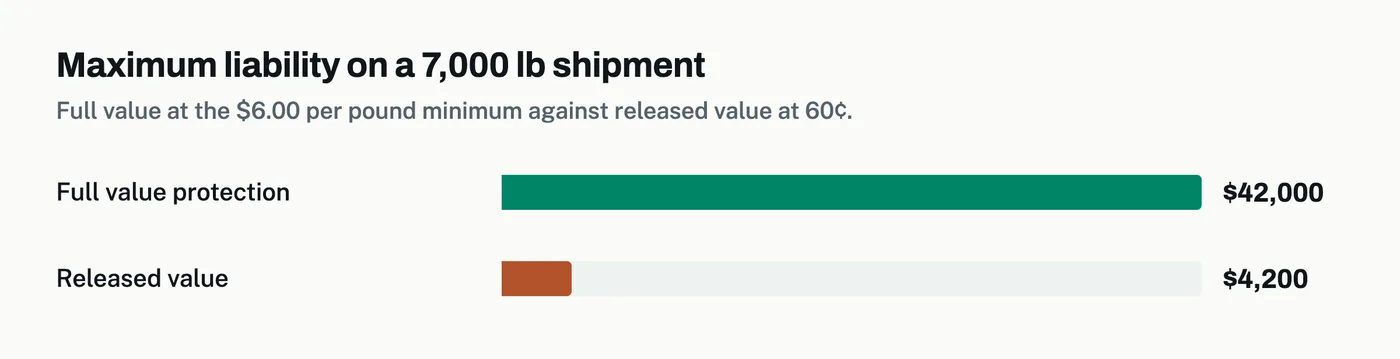
Our arithmetic on those figures:
- A 7,000 lb shipment: at least $42,000 of liability at full value; $4,200 released.
- A 150 lb sofa, destroyed, under released value: $90, whatever it cost.
- Under 1,000 lb, the $6,000 minimum is the figure that applies.
Ten to one. That ratio is the reason the waiver is a signature and not a tick-box, and the reason a customer who was never shown the full-value price has a complaint worth making.
What you are allowed to price
The federal sources set no price for full value protection. The mover does — but the decision is specific about where: the charge, and every deductible variant you offer, must be in your tariff. A figure quoted off the top of your head that is not in the tariff is the exposure, not the number itself.
Three more details the pages we read leave out:
- High-value articles. Under §375.203, if the shipper does not tell you in writing about articles worth more than $100 a pound, your liability for them may be limited to $100 a pound. The inventory form for that is in the decision's appendix. Ask the question; it protects both sides.
- Weight on a binding estimate. If the customer takes full value without declaring a value, the decision says the shipment must be weighed on a certified scale. Without that weight, liability is replacement value with no dollar limit.
- It is not insurance. The decision's own bill-of-lading wording says so in capitals. §375.303 lets a mover sell or procure actual insurance only where the shipment is released at 60 cents or less. Call full value protection what it is.
What that means for a number on your website
An online figure for an interstate move is a ballpark, not the estimate — no survey has happened yet, as we covered in the post on the survey rule. But the same logic applies to what the ballpark includes. If the real estimate must be priced at full value, a web range priced at released value is a number the customer will never be offered by default.
- Build the range at full value, and show the released-value saving as the option it is.
- Ask for anything over $100 a pound up front. It is a short question with a clear answer.
- Price from your tariff. If the web calculator and the tariff disagree, the tariff wins and the calculator is wrong.
Where these figures come from
Regulatory text is from 49 CFR 375.201, 375.203, 375.303 and 375.401 as shown on the eCFR, up to date as of 7 October 2026. The estimate notice, the $6.00 and $6,000 minimum, the deductible and tariff requirements and the certified-weight rule are from the Surface Transportation Board's decision in RR 999 (Amendment No. 5), served 12 January 2012 and effective 2 April 2012, read from the Board's PDF. All were read on 11 October 2026. We found no later amendment and did not rule one out; FMCSA's own pages refused our requests. All of this covers interstate moves for individual shippers only — moves within one state answer to that state. The count of pages is our own; they are counted, not named. This is a reading of the rules, not legal advice.
This is the product, if you want it.
Quote Engine puts a real price on a service business's own website — built from what you already charge, and honest enough to hand over the jobs it should not price.