16 October 2026 · 6 min read
How to price refrigerator removal: the federal rule behind the freon fee
A refrigerator is the one item on the truck with a federal rule attached. The rule is why the gate charges for it by the unit, not the ton.
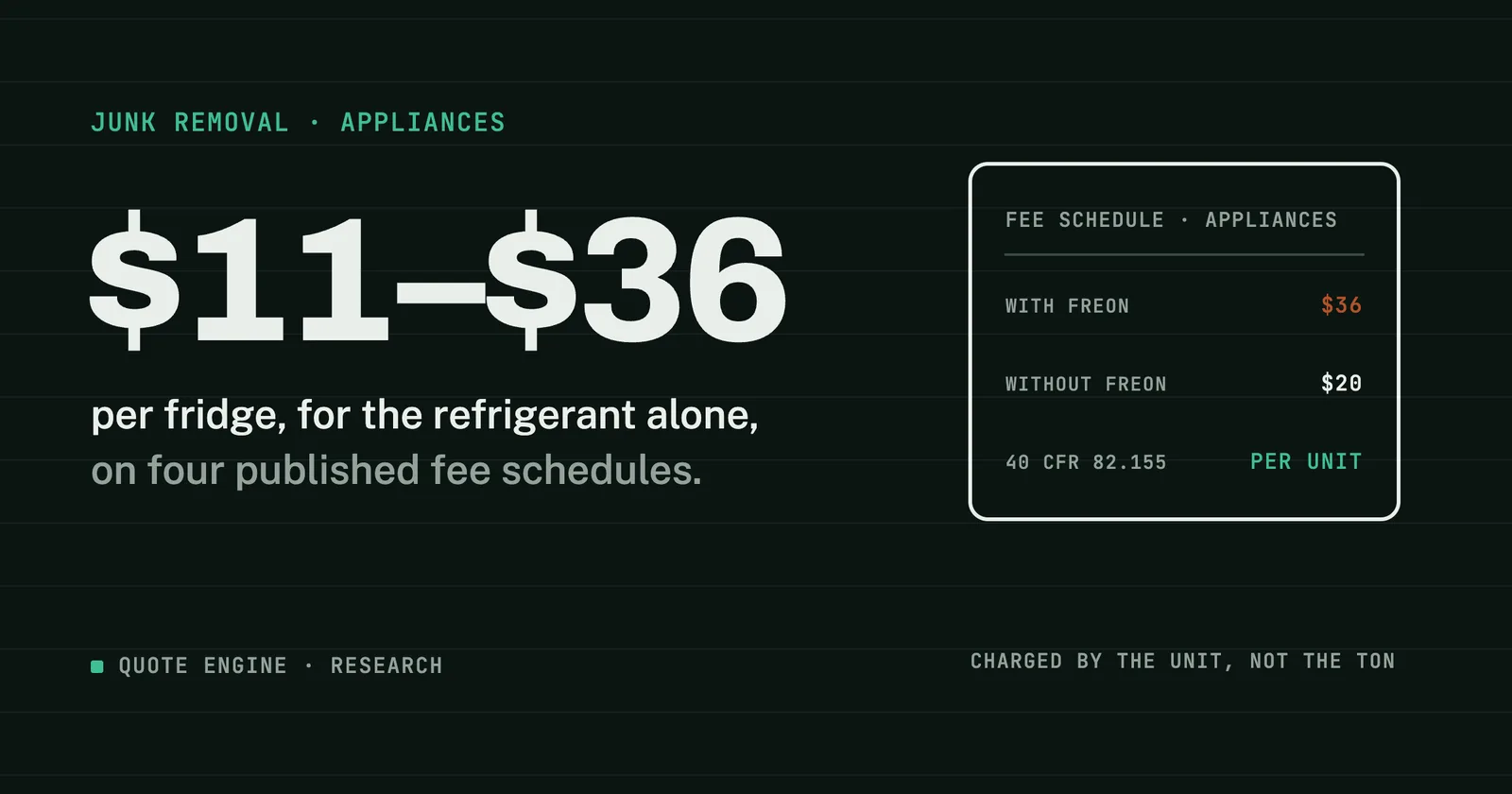
Search how to price refrigerator removal and the guides give you a flat figure. A fridge is treated as a heavy item: awkward, two people, a bit more than a couch. None of them say why the dump treats it as something else entirely.
What the ranking guides say
We read five owner-facing junk removal pricing guides on 11 October 2026, across four versions of that search. Counted:
- 3 of 5 give a refrigerator price: $100–$200 on two of them, $135 on a third.
- 5 of 5 mention disposal fees in general. 0 of 5 give a real per-unit fee for a refrigerated appliance from any site.
- 0 of 5 mention the EPA, the Clean Air Act or refrigerant recovery. One uses the word refrigerant, once.
The rule
Refrigerators, freezers and window air conditioners are "small appliances" under federal refrigerant rules, and their disposal is covered by 40 CFR 82.155. The duty lands on what the rule calls the final processor: "persons who take the final step in the disposal process (including but not limited to scrap recyclers and landfill operators)."
That facility has two choices for every unit that arrives:
- recover whatever refrigerant is left in it, with certified equipment; or
- verify, by a signed statement or a contract, that it has already been recovered. A signed statement "must include the name and address of the person who recovered the refrigerant and the date the refrigerant was recovered."
It must keep those statements for three years. EPA's own summary adds two details worth knowing: a sticker on the unit is not accepted as verification, and the people who recover refrigerant at disposal do not have to be certified technicians, though their equipment has to meet the same standard as a service technician's.
Separately, and for everyone, venting refrigerant is prohibited — including while disposing of equipment. Cutting the lines to make a unit "empty" is the violation, not the workaround.
Why that becomes a per-unit fee
A landfill can weigh a couch. It cannot weigh its way out of 82.155: each fridge is a recovery job or a piece of paperwork. So the fee schedule charges by the unit. Four published examples, each from the authority's own page:
| Where | Unit with refrigerant | Without |
|---|---|---|
| Larimer County, CO landfill, 2026 schedule | $36 | $20 |
| Montgomery County, NY transfer stations, 2026 | $20 freon removal | — |
| Ledgeview, WI | $15 | $5 |
| Mesa, AZ appliance pickup | $11 freon fee, on top of $19 | $19 |
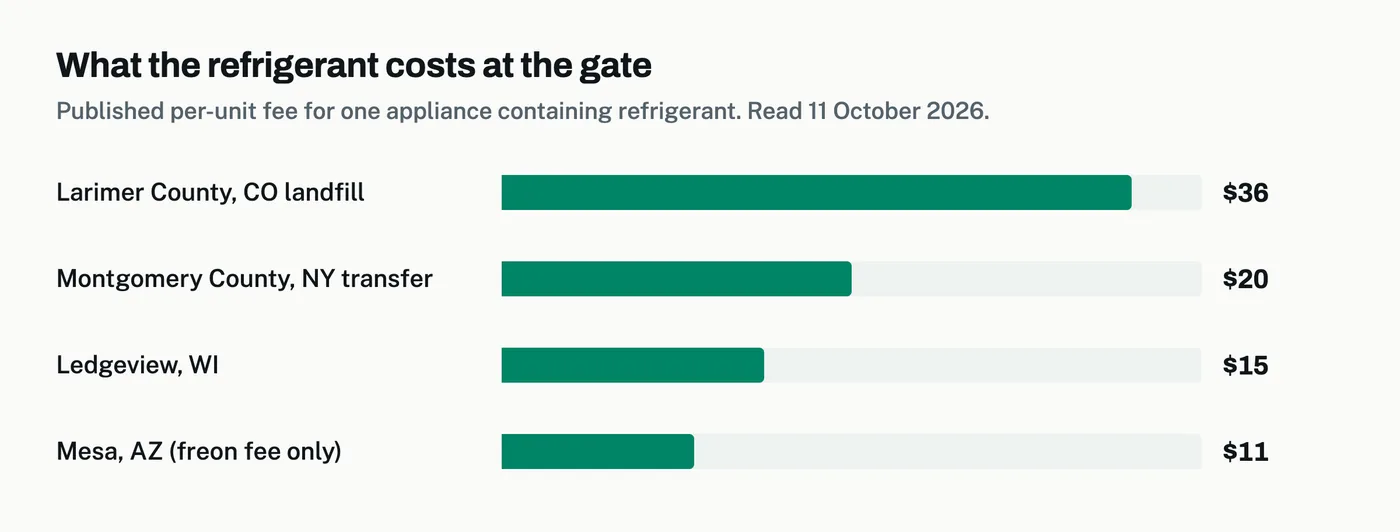
The first two are gate fees. The last two are municipal charges to residents and are here to show the size of the refrigerant premium: $16 in Larimer, $10 in Ledgeview, $11 in Mesa.
Montgomery County's schedule has a second line that matters more than the first: bulky white goods mixed in with household waste are $25 a unit plus the $120.50 per ton tip fee. The same fridge costs $20 on its own and more than that buried in a load. Separation is not tidiness; it is on the price list.
What that does to a $135 fridge
Our arithmetic, on the figures above:
- At a $36 gate fee, 27 percent of a $135 price is gone before fuel or labour. At $20 it is 15 percent.
- The same job leaves $99 in one county and $115 in another. A flat national price cannot be right in both.
- Three fridges from one estate cleanout is $108 at the first gate, which no eighth-of-a-truck tier knows about.
How to put it in the price
- Read your own gate's schedule and use that number. It is published, it is per unit, and it changes once a year. This is the easiest cost in the business to get exactly right.
- Make it its own line. "Refrigerator, includes refrigerant disposal fee" tells the customer why it is not the same as a washer, and it survives the comparison with a competitor who left it out.
- Ask the question that sets the fee. Fridge, freezer, window unit, dehumidifier: does it have a compressor? The customer knows. That one answer is the difference between the two columns in the table.
- Know which route your site uses. If it recovers on site, you pay the fee. If it wants a signed statement, somebody with recovery equipment has to have emptied the unit first, and their name goes on the paper.
An item the customer can name, with a cost you can read off a schedule, is exactly the kind of job that can be priced before anyone drives out.
Where these figures come from
Rule text is quoted from 40 CFR 82.155 as shown on the eCFR, up to date as of 7 October 2026, and from EPA's safe-disposal and venting pages, all read on 11 October 2026. Fees are from each authority's own page or schedule, read the same day; two of the four are charges to residents rather than commercial gate rates, and we did not confirm which sites accept commercial haulers at the listed price. The count of guides is our own; they are counted, not named. State and local rules can be stricter than the federal one. This is a reading of the rule, not legal advice.
This is the product, if you want it.
Quote Engine puts a real price on a service business's own website — built from what you already charge, and honest enough to hand over the jobs it should not price.