6 October 2026 · 7 min read
How to price a local move when your state sets the rate
In two West Coast states the hourly rate on your website is bounded by a document the state publishes, and in one of them the bounds moved three times this year.
Search how to price a local move and the advice is consistent: charge by the hour, per crew, with a minimum; add up labour, truck, fuel and overhead; put a margin on top. All of that is right. What the guides leave out is that in some states the number you arrive at has to land inside a band the state has already printed.
What the ranking guides say
We read the five pages ranking for that search on 6 October 2026, skipping homeowner cost guides and directories: FreshBooks, LoadUp, Roooster, Wexford Insurance and Billbooks. All five are written for owners, and they are useful. Counted across them:
- 3 of 5 put an hourly figure on the page. Billbooks gives $100 to $150 an hour for two movers and a truck.
- 1 of 5 mentions state law at all — LoadUp notes that pricing by volume is illegal in some states.
- 0 of 5 mention a state rate tariff, a minimum rate or a maximum rate.
- 0 of 5 discuss what a mover may say about price on their own website.
For a mover in most of the country that silence costs nothing. For one working moves inside Washington or California it leaves out the document that decides the answer.
Washington: a floor and a ceiling
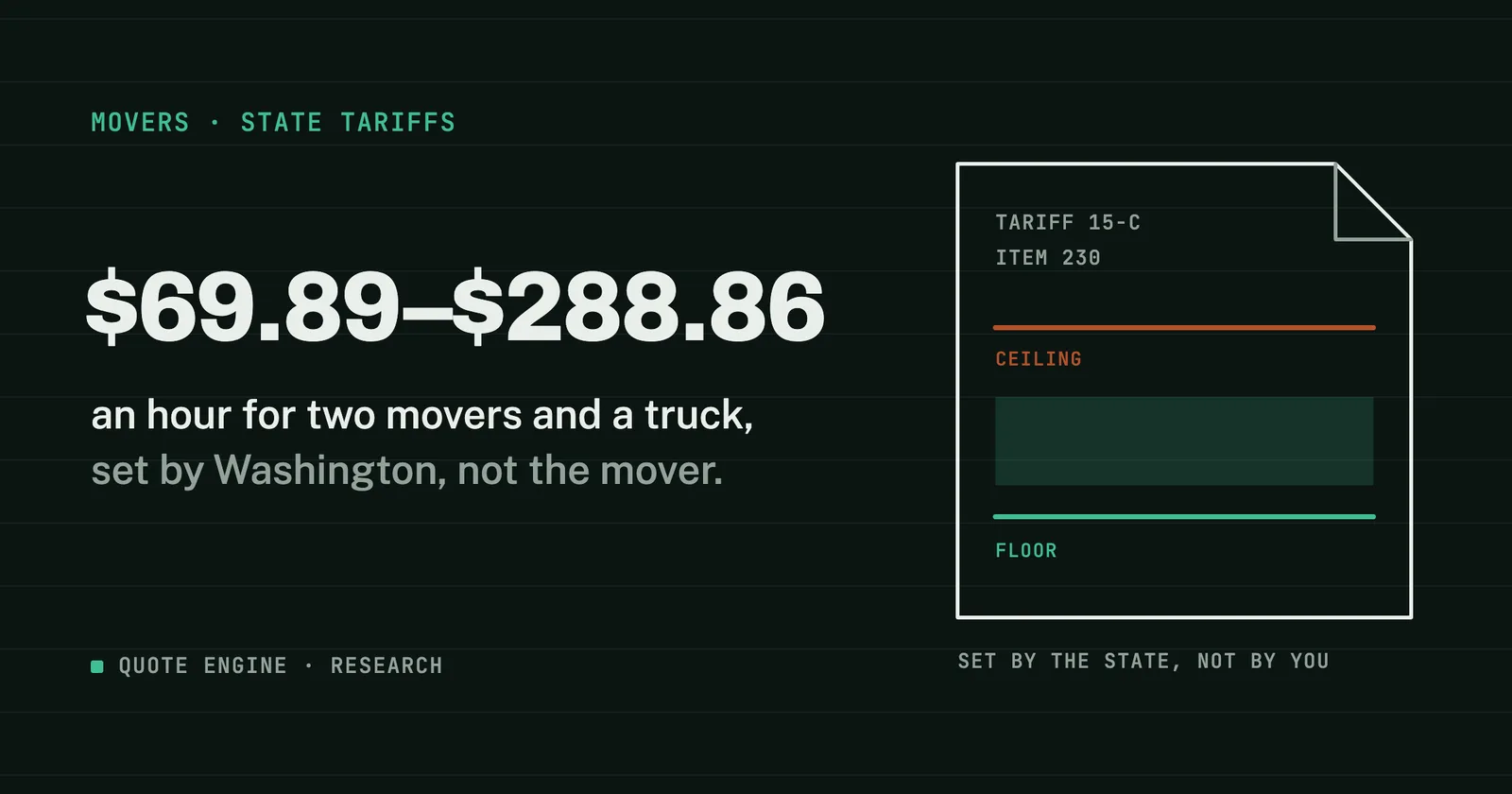
Washington's Utilities and Transportation Commission says it plainly: it sets the minimum and maximum prices that licensed in-state movers can charge, and a mover cannot go below the one or above the other. The numbers live in Tariff 15-C, Item 230, for moves of 55 miles or less. As printed, effective 1 January 2026:
| Per hour, regular hours | Move of 3 hours or less | Move over 3 hours |
|---|---|---|
| Truck and driver | $39.20–$154.38 | $37.93–$149.40 |
| Each additional worker | $30.69–$134.48 | $29.63–$129.83 |
| Two movers and a truck | $69.89–$288.86 | $67.56–$279.23 |
The last row is our addition of the two above it. The same item sets the rules an hourly price is computed by: a one-hour minimum in regular hours and four hours on evenings, weekends and holidays; time recorded to the nearest 15 minutes; breaks the crew takes not billed; and the clock running from when the truck leaves the terminal, or a flat travel time instead. A mover can file for a shorter minimum or one-minute increments, but the choice then applies to every customer.
The ceiling moved three times this year
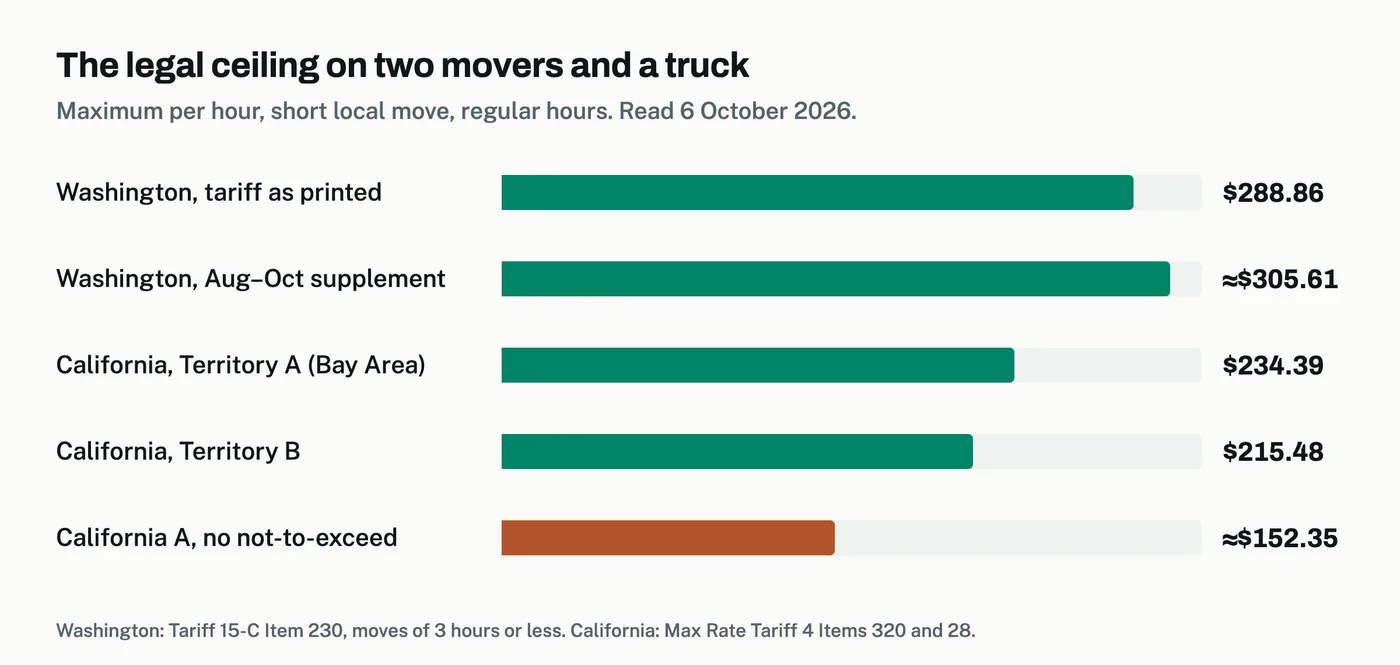
The printed table is not the whole story. In December 2025 the Commission ordered a 25 percent increase to the top of the band, effective 1 January. In April it added a temporary 3.35 percent to the maximum rates from 1 May to 31 July, citing diesel. And in Order 02 in Docket TV-260270, dated 30 July, it replaced that with a 5.8 percent increase to all maximum rates, effective 1 August and expiring 31 October 2026. By our arithmetic that puts today's ceiling for two movers and a truck on a short move at about $305.61 an hour — and in four weeks, unless another order follows, it drops back.
California: a ceiling, and a penalty for leaving the price off
California's Bureau of Household Goods and Services publishes Maximum Rate Tariff 4, effective 1 January 2026. There is no floor. The ceiling, in Item 320, applies to moves of 100 miles or less and depends on territory: Territory A is San Francisco and the counties of Alameda, Contra Costa, Marin, Monterey, San Mateo, Santa Clara, Santa Cruz and Sonoma; Territory B is everywhere else.
| Maximum per hour, straight time | Territory A | Territory B |
|---|---|---|
| Truck and driver | $145.99 | $139.36 |
| Truck, driver and helper | $234.39 | $215.48 |
| Each person beyond two | $84.09 | $72.71 |
Two rules in the same tariff matter more to a website than the rates do. First, the notice every mover must print: no rate above the maximum may be quoted or charged unless a written Estimated Cost of Services was issued at least three days before the move — and that estimate may only be given after a visual inspection of the goods. Second, Item 28: if the Agreement for Moving Services does not state a Not to Exceed Price, the charges fall to the lowest of 65 percent of the maximum rates and whatever rates were quoted. In Territory A that is about $152.35 an hour for two movers and a truck — almost exactly where the guides' typical range sits.
The tariff allows the agreement, with its Not to Exceed Price, to be sent and signed electronically. What it does not allow is a price on a page that never becomes that number on that form.
What this means for a price on your website
Washington is the more interesting case, because its rule anticipates exactly the thing the guides skip. Under WAC 480-15-630, a mover may not move goods it has not inspected unless the customer completes a "website calculation" — and the mover may base a written estimate on it. The conditions are specific. The customer signs by typing their name and the date. The estimate must carry every element the tariff requires and come with the state's consumer guide. And it must say, on the website, that it is not binding, that the cost may exceed it, that the customer pays up to 110 percent on delivery with at least thirty days for the rest, and never more than 125 percent without a signed supplemental estimate.
That rule dates from January 2008. The online quote in Washington has had a legal shape for nearly nineteen years; it just has to be built to it. Taken together, the two tariffs ask four things of any hourly price a mover publishes in those states:
- Stay inside the band. A promotional rate under $69.89 for two movers and a truck is not a deal in Washington; it is a violation. A premium rate over the California ceiling needs an inspected estimate three days out.
- Compute it the way the tariff does. Minimums, 15-minute rounding, the three-hour break between rate bands, travel time from the terminal. A calculator that rounds differently from the bill of lading is quoting a number the mover cannot charge.
- Date it. A Washington ceiling that changed on 1 January, 1 May, 1 August and, unless renewed, on 1 November is not a figure to hard-code into a page. Every published price should know which version of the tariff it was computed under.
- Say what kind of number it is. Washington requires the nonbinding wording on the page itself. California makes the Not to Exceed Price the number that counts. Either way the customer is told what the figure commits the mover to.
Check your own state first
These are two states, read in full; they are not a survey of fifty. Interstate moves are federal, and we have written up what the 2022 rule changed there. Inside other states the regulator, the tariff and whether rates are set at all vary, so before pricing a local move from any national guide, find out whether your state publishes a tariff — and if it does, price from that page, not this one.
Where these figures come from
Washington's rates and rules are quoted from Tariff 15-C as effective 1 January 2026 (Items 85 and 230), the 3.35 percent supplement, and Order 02 in Docket TV-260270, all downloaded from the Commission's site; the website-calculation rule is WAC 480-15-630 as published by the Legislature. California's are quoted from Maximum Rate Tariff 4 effective 1 January 2026 (Items 28, 108, 210 and 320) on the Bureau's site. The five guides were read for the counts above. Everything was read on 6 October 2026. The two-mover totals, the supplemented ceiling and the 65 percent figure are our arithmetic on the published rates, marked as approximate where the regulator's rounding could move a cent. Tariffs change — the Washington supplement expires on 31 October — so check the regulator's current page before relying on a figure here. This is not legal advice.
This is the product, if you want it.
Quote Engine puts a real price on a service business's own website — built from what you already charge, and honest enough to hand over the jobs it should not price.