13 October 2026 · 6 min read
How much to charge for a steep roof: where the regulation actually draws the line
The trade starts charging for pitch somewhere between 7:12 and 10:12. The rule that costs you money starts at six feet off the ground.
Search how much to charge for a steep roof and you will find pitch tables, area multipliers and a general agreement that steep roofs cost more. What you will not find is agreement on where steep begins — or any mention of the one document that defines it.
What the ranking guides say
We read the five owner-facing pages ranking for that search on 11 October 2026, skipping homeowner cost pages and directories. Four more would not load and are not counted. Of the five:
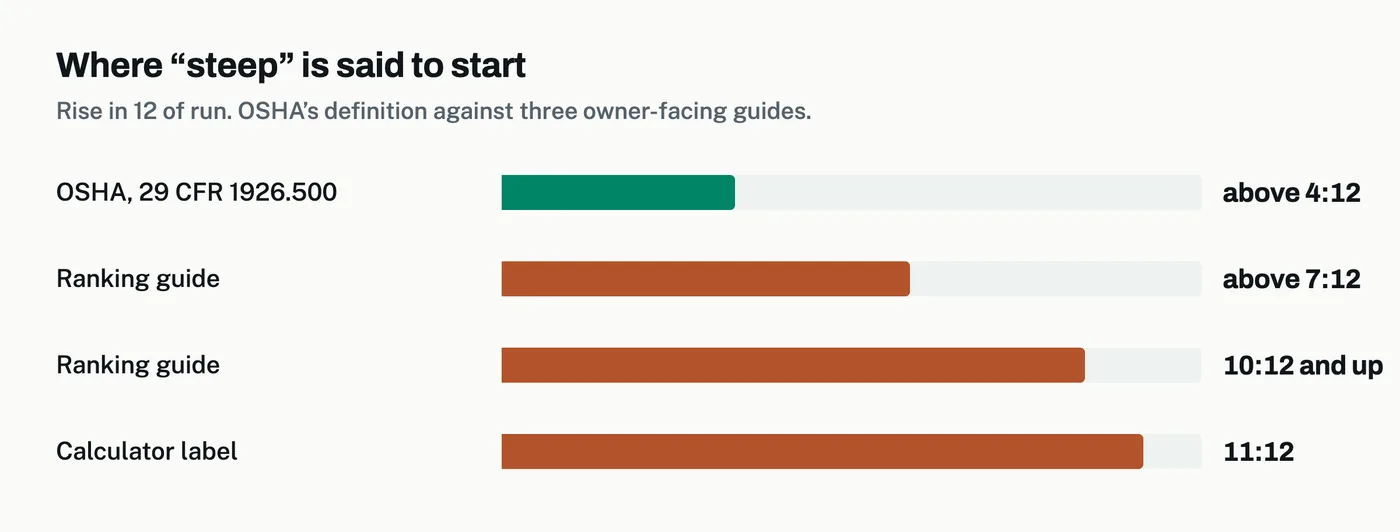
- 2 of 5 name a pitch where steep starts. One says above 7:12, the other 10:12 and up.
- A third labels its calculator: steep at 11/12.
- 0 of 5 give a pitch-only upcharge, as a percentage or per square.
- 0 of 5 cite OSHA, or any section of the construction standard.
Four of the five do publish an area multiplier by pitch, and those disagree too: a 4:12 roof is 1.054 times its footprint on one page and 1.20 on another. The first is geometry. Whatever is in the second, the page does not say.
The line that is written down
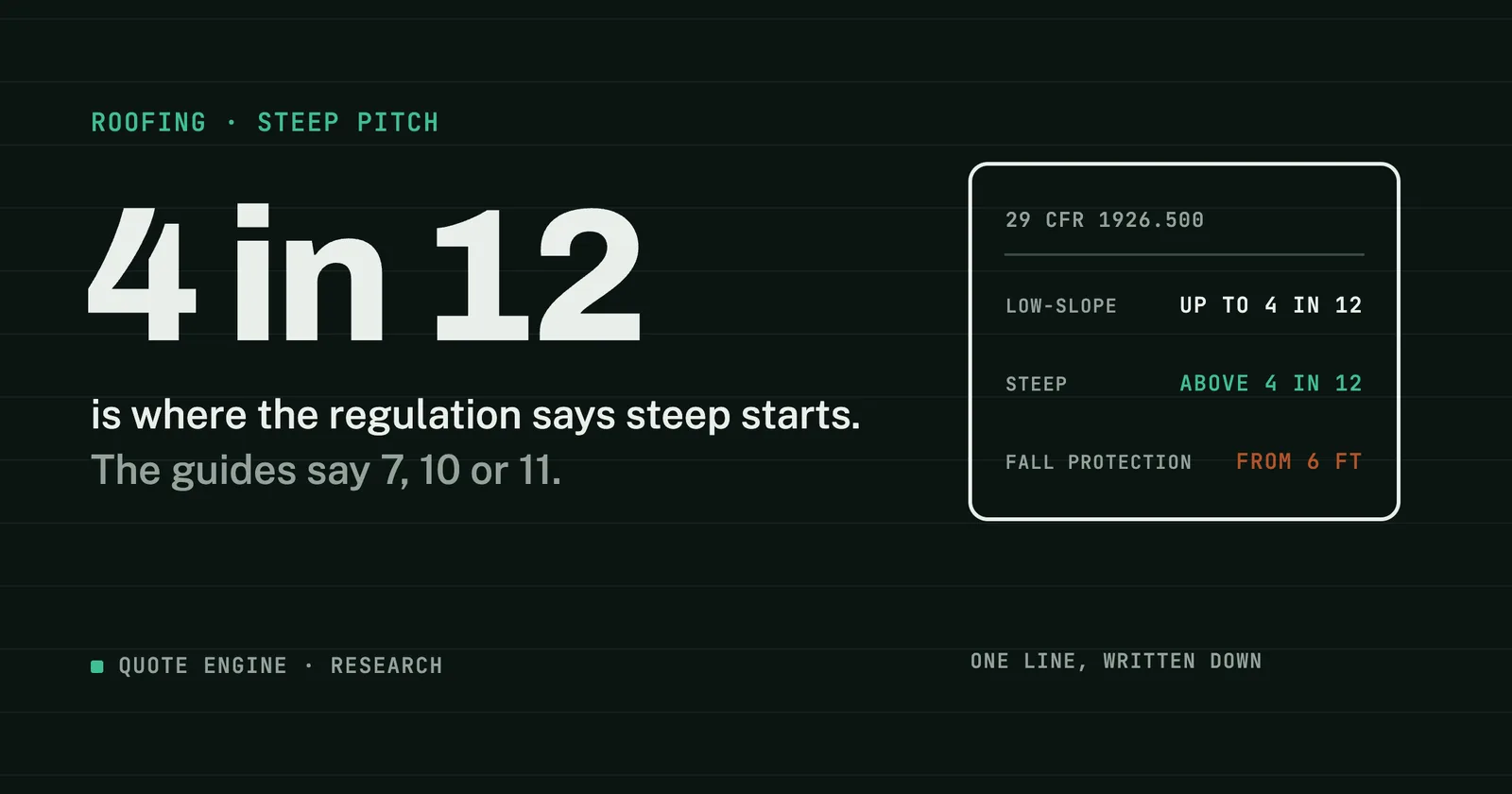
The federal construction standard defines the word. 29 CFR 1926.500(b): a low-slope roof is one "having a slope less than or equal to 4 in 12." A steep roof is one "having a slope greater than 4 in 12." There is no second threshold. Nothing in the standard changes at 7, 8 or 10 in 12.
What changes at 4 in 12
The definition matters because the duty differs on either side of it, in §1926.501(b):
| Low-slope, (b)(10) | Steep, (b)(11) | |
|---|---|---|
| Trigger | 6 feet above lower levels | 6 feet above lower levels |
| Allowed | Guardrails, nets, personal fall arrest, or a warning line combined with one of those or with a safety monitor | Guardrails with toeboards, nets, or personal fall arrest |
On a low-slope roof 50 feet wide or less, a safety monitor alone is permitted. Above 4 in 12 the warning line and the monitor are gone. That is the whole legal effect of pitch.
And for most of the work a residential roofer does, even that distinction is narrower than it looks. §1926.501(b)(13) covers residential construction separately: six feet or more above lower levels, protected by guardrails, nets or personal fall arrest, unless another provision allows an alternative or the employer can show those are infeasible and writes a site-specific fall protection plan. OSHA's residential compliance directive, in effect since June 2011, withdrew the older interim policy that had allowed looser alternatives.
Put plainly: the regulation does not make a 9:12 roof a different job from a 5:12 one. It makes a roof whose eave is six feet up a different job from one that is not — and almost every house is the first kind.
What that does to the estimate
It splits the steep charge into two things the guides run together.
- The cost of tying off is not a pitch charge. Anchors, harnesses, lifelines, the time to set them and move them: the rule asks for these at six feet on any slope. That belongs in your base price per square, not in a line that only appears at 8:12.
- The pitch charge is a productivity charge. Past the point your crew can walk the roof, they work from jacks and planks, carry less per trip and lay fewer squares a day. That is real, it is yours to measure, and it is why the guides cannot agree — each author's crew slows down at a different pitch.
- The area multiplier is a third thing. A 6:12 roof has 1.118 times the surface of its footprint and a 12:12 roof 1.414 times; that is the square root of one plus the slope squared, and it buys shingles, not labour. If your table says more than geometry does, know what else is in it.
So the honest number comes from your own job history: squares per crew-day at each pitch band you actually work. Where that figure drops is where your upcharge starts, and the size of the drop is the size of the charge.
What skipping it costs
OSHA's penalty page puts the maximum for a serious violation at $16,550, and for a willful or repeated one at $165,514. A memo of 21 May 2026 confirms the 2025 amounts stay in effect for 2026 and sets the minimum for a serious violation at $1,085. Fall protection, §1926.501, sits first on OSHA's preliminary most-cited list for fiscal 2026.
A roofer who prices fall protection only above 8:12 is working every roof below it with that exposure and nothing in the price to cover the gear.
What to put in front of a homeowner
Pitch is one of the few things about a roof that can be known before anyone climbs it — a measurement report states it. That makes the pitch band a fair input to a published range: this size, this pitch, this material, from this to this. What it cannot carry is the condition underneath, and the range should say so.
Keep the bands few and the line visible. "Steep-pitch labour, above 8:12" as its own line tells the homeowner why the neighbour's quote was lower, and it is the line you can defend, because it came from your own crew-days.
Where these figures come from
Regulatory text is quoted from 29 CFR 1926.500 and 1926.501 as shown on the eCFR, up to date as of 7 October 2026, read on 11 October 2026. Penalty amounts are from OSHA's penalties page and its 21 May 2026 memo, read the same day; the most-cited list is labelled preliminary and the page gives no counts. The count of guides is our own, from the five owner-facing pages we could load; they are counted, not named. The area factors are geometry. States that run their own OSHA plan can set stricter rules, which we did not check. This is a reading of the standard, not legal or safety advice.
This is the product, if you want it.
Quote Engine puts a real price on a service business's own website — built from what you already charge, and honest enough to hand over the jobs it should not price.